Your direct booking conversion rate is hiding the real problem
One sitewide number blends returning guests, marketplace checkers and casual readers. Split it by visitor, run a 30-minute check with tools you already have, then decide what to fix first.
Key points
- One sitewide conversion rate blends visitors who were ready to book with visitors who never will. It can fall while your bookings rise.
- Most direct bookings come from four visitors: returning guests, marketplace checkers, need-specific searchers and area browsers. Measure each one separately.
- A 30-minute check with your PMS, GA4 and Search Console shows whether you have a traffic, a site or a tracking problem.
- Fix pages first, change the structure second, rebuild last. A missing page is rarely a reason to change platform.
Your booking engine works. Your calendar syncs, payments go through, and the site looks fine on a phone. Yet when you open analytics, the conversion rate is a small number that drifts a little lower each quarter, and nobody can say why.
That single number is the problem. It blends guests who are ready to book with people who were never going to, and it hides the three or four different kinds of visitor who actually decide whether your direct channel grows. This guide shows you how to split the number, run a 30-minute check with tools you already have, and decide whether you need to fix pages, change how the site is organized, or rebuild it.
Why one conversion rate misleads you
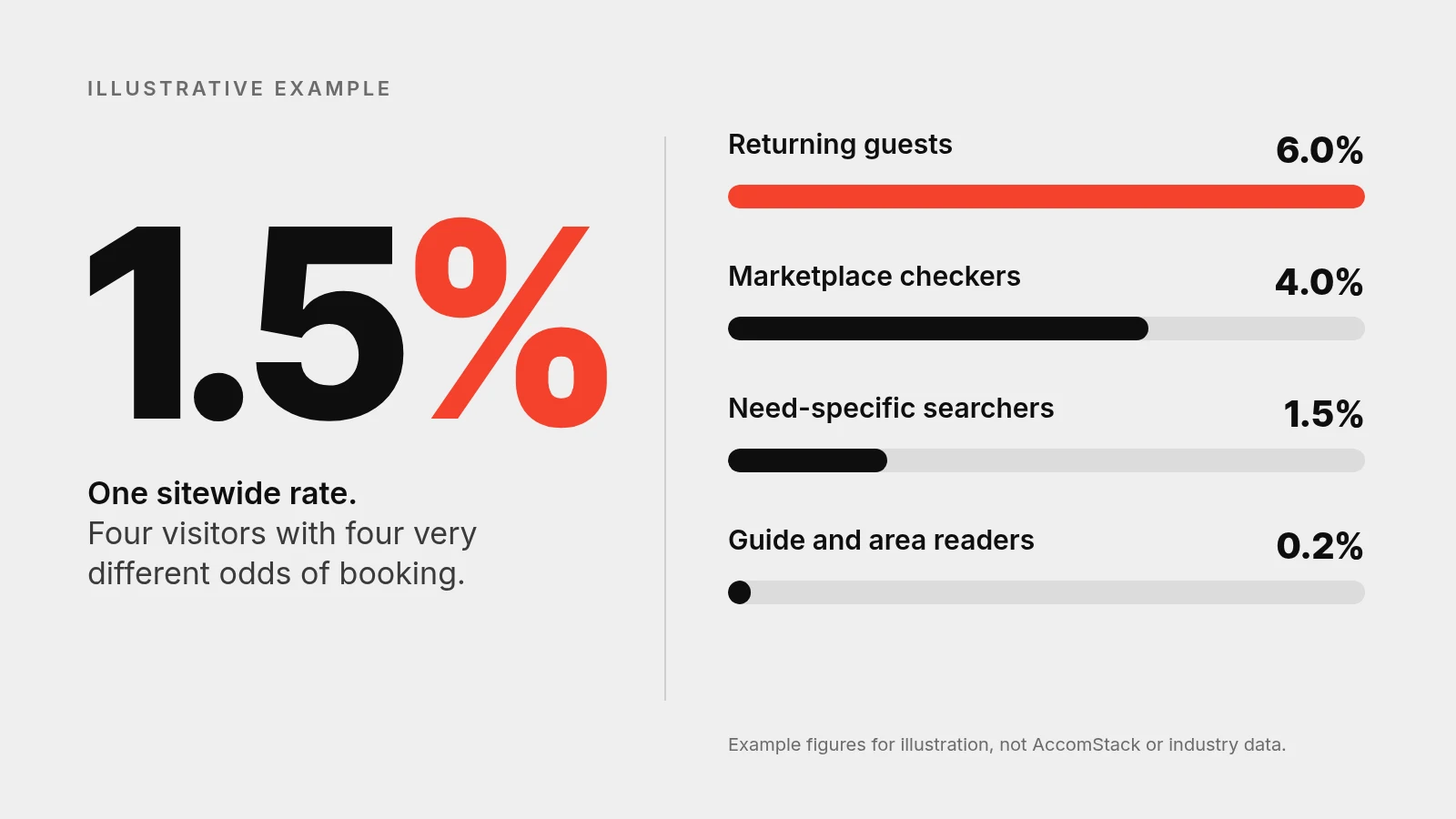
The usual formula is bookings divided by sessions. It sounds fair, but sessions include a lot of visits that were never a booking chance: a past guest checking their reservation, someone reading your guide to a local festival, a cleaner looking for work, a homeowner curious about management. Add a good article that brings in readers and the rate falls, even though nothing on the booking path changed.
Here is a simple example. The numbers are invented to show the arithmetic, not taken from any real business.
Month 1
1.51%
151 bookings from 10,000 sessions
Month 2
1.14%
159 bookings from 14,000 sessions
- Returning guests (6.0%)
- Marketplace checkers (4.0%)
- Need-specific searchers (1.5%)
- Guide and area readers (0.2%)
Nothing broke in month 2. The mix changed. If you only watch the sitewide rate, you would spend time fixing a booking path that is working. Splitting the number by visitor type is the cheapest way to avoid that.
The four visitors who decide your direct bookings
For an operator with anywhere from one to fifty homes, most direct bookings come from four kinds of visitor. They arrive with different questions and need different things from your site.
| Visitor | What they are thinking | What your site must show | Number to watch |
|---|---|---|---|
| Returning guest | "Can I book the same place again without starting over?" | A clear way back: a rebooking link in the departure email, a recognizable name, a returning-guest offer | Share of last year's returning guests who rebooked direct |
| Marketplace checker | "I found you on Airbnb or Vrbo. Is this the same place, and is it safe to book here?" | The same property, the same photos, a visible business name, reviews, secure payment, a plain reason to book direct | Booking rate for visitors who searched your brand or property name |
| Need-specific searcher | "Which place works for six adults, two dogs, or a month-long stay?" | A page for that need, with the deciding facts (beds, parking, pets, steps) visible before the property page | Booking rate from those landing pages |
| Area browser | "Where should we stay in this town?" | A useful area guide that links to the homes that suit each part of town | Clicks from area guides to property pages |
Two of these are easy to underserve. The marketplace checker is the first. Hotel researchers at Cornell called the lift that a marketplace listing gives a hotel's own channels the "billboard effect"3. Their work was on hotels, a decade and a half ago, so treat it as a pattern rather than a rental statistic. But the behavior is easy to recognize: a traveler sees you on a marketplace, then looks you up. They are not browsing. They are checking.
What they check is trust. In a 2026 survey of 1,204 short-term rental guests by TouchStay, 69% said they would book direct to save 10 to 15%, and another 26% said they would if they trusted the host. The most common thing guests said would build that trust was a professional website with detailed information (59%), ahead of secure payment (44%) and reviews (39%)2. TouchStay sells guest guidebook software, so read the survey as one vendor's data. Even so, it points the same way as common sense: a nervous guest needs evidence, not a discount.
The second is the returning guest. They already like you. If rebooking is harder than tapping a marketplace app, many will drift back to the marketplace without ever deciding to.
If you also manage homes for owners, there is a fifth visitor, the prospective owner, and they should be measured separately from guests. If you only run your own homes, ignore that one.
When this advice fits, and when it does not
A fair challenge to everything above: splitting traffic into groups only helps if each group is big enough to measure. If your site gets 40 booking-intent visits a month and 3 direct bookings a year, a "rate" for each group is mostly noise. One extra booking moves it by a third.
In that case, skip the percentages and count things instead. How many past guests rebooked direct? How many bookings came from people who searched your name? How many enquiries asked a question your site should have answered? With one to three homes, the returning guest and the marketplace checker are most of the story, and the other two groups can wait.
A 30-minute check you can run this week
You need your property management system (PMS), Google Analytics 4 (GA4) and, if you have it, Google Search Console. Nothing here costs money.
- Count returning guests. In your PMS, list last year's guests who stayed more than once or came back, and note how many of their latest bookings were direct and how many came through a marketplace. This tells you whether your site gives past guests a way back.
- Look at brand searches. In Search Console, open the Performance report for Search results and use the branded queries filter. It separates searches that include your brand name from the rest. Google notes that the filter is not available for sites with low impressions, and it only holds data since March 20254. If it is missing for you, filter the Query list by your business name by hand. Then check in GA4 whether those visitors book. These are mostly returning guests and marketplace checkers.
- Group your landing pages. In GA4, open Reports, then Engagement, then Landing page5. Sort each page into home, property, collection or need-specific page, area guide, blog, and other. Note which groups produce bookings and which only produce visits.
- Reconcile the counts. For one recent month, compare direct bookings in the PMS with booking events in GA4. If your booking engine lives on a different domain from your site, GA4 needs cross-domain measurement so that one guest is not counted as two visitors. The setting is under your web data stream's tag settings, in Configure your domains6. If the two counts are far apart, fix the tracking before you judge the site.
How to read what you find
| What you see | What it usually means |
|---|---|
| Returning guests booked through a marketplace | Your site gives them no easy way back. Add a rebooking link to your emails and a returning-guest note on the site. |
| Brand searchers visit but do not book | Marketplace checkers are not finding proof or a reason to stay. Check that the property, photos, reviews, policies and total price match what they saw on the marketplace. |
| Non-brand visitors only land on the home page | No page exists for the guests you want. Build one for your best-fit need, for example pet-friendly, long stays or larger groups. |
| PMS and GA4 booking counts disagree by a lot | You have a measurement problem. Fix tracking first. |
| Traffic is mostly readers who never view a property | Your content is working as content. Judge it on clicks to property pages, not on bookings. |
Fix pages, change the structure, or rebuild?
The check usually points to one of three jobs, and they differ a lot in cost. Start with the smallest one that fits.
First: do your PMS and GA4 booking counts roughly agree? If not, fix tracking before you choose any of these.
- Smallest job
Fix pages
Choose it when the right guests reach the right page but stall there.
Typical work Missing facts, unclear total price, thin policies, weak proof.
- Medium job
Change the structure
Choose it when a group of guests you want has nowhere relevant to land.
Typical work A page for each need, a way back for past guests, area guides that link to homes.
- Largest job
Rebuild
Choose it when the platform itself blocks the pages or the tracking you need.
Typical work New platform or front end, with a plan to keep the search traffic you already have.
Fix pages when guests land in the right place and still leave. The cause is usually something they could not find or did not trust. Our direct booking website guide walks through the ten questions guests ask before they pay.
Change the structure when the visitors you want have nowhere to land. This is mostly planning and writing, and you can often do it inside the booking tool you already pay for.
Rebuild only when the platform cannot hold the structure you need or cannot be measured properly. If you do, protect the search visibility you have before you switch.
Why this is worth doing now
Every booking that could have been direct costs more on a marketplace than it used to. Airbnb's help center says its single fee structure, where the whole fee comes out of the host's payout, is mandatory for most hosts, including hosts who use property management software, and that most hosts on it pay 15.5%1. Fees differ by channel, so run your own numbers. The direct booking savings calculator shows what moving a share of bookings direct is worth for your homes.
What to do this week
- Write down your own version of the four visitors. For each, one sentence on what they ask and one number you can pull.
- Run the four-step check above. It takes about half an hour.
- Pick one fix from the "how to read it" table and do it before you touch the design.
- Check again in a month, by group, not by sitewide rate.
See what a direct booking is worth
Free direct booking savings calculator. No signup.
Sources
- Airbnb Help: Airbnb service fees (single fee structure)
- TouchStay: What 1,204 guests reveal about the direct-booking opportunity (vendor survey)
- Cornell eCommons: Search, OTAs, and Online Booking: An Expanded Analysis of the Billboard Effect (hotels, 2011)
- Search Console Help: Performance report, branded and non-branded queries filter
- Analytics Help: [GA4] Landing page report
- Analytics Help: Configure your Google tag settings (Configure your domains)
Last checked 4 October 2026. Fees, survey figures and Google report options change; confirm on each source before you act. The figures in the charts and the worked example are invented to show the arithmetic and are not data from AccomStack or any operator. All graphics were made by AccomStack; the article uses no third-party photos or screenshots. This article is general information, not legal, tax or financial advice.